
Quick summary
- A T-money card costs a few thousand won and works on subways, buses, many taxis and in convenience stores nationwide.
- The card price is a purchase, not a deposit, so only the balance you load can be refunded.
- Topping up at a convenience store is cash based, though station kiosks and the mobile app now accept some overseas cards.
- Refund your leftover balance at a convenience store before you pass airport security, not after.
Almost every guide to Korea tells you to get a T-money card, and that advice is right. What those guides often skip is the part that actually trips people up: you can buy the card with a foreign card, but loading money onto it usually needs Korean cash. Knowing that before you land saves you standing at a convenience store counter wondering why your card keeps getting declined.
What the card actually does
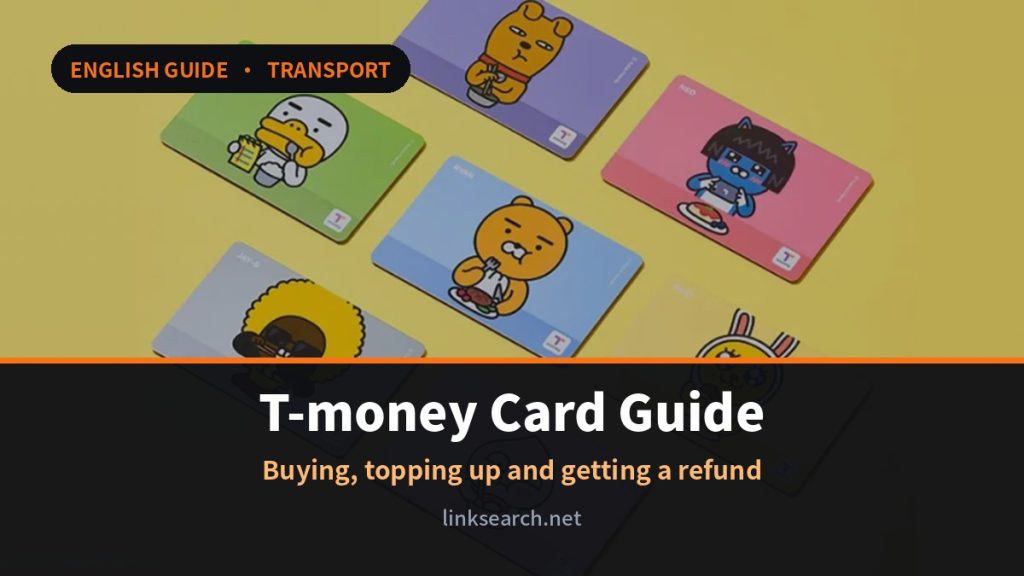
It is a rechargeable contactless card, similar to Oyster in London or Suica in Tokyo, except it covers more than transit. You tap it on subway gates, bus readers and many taxi terminals, and you can also pay with it at convenience stores and some fast food counters. The same card works in Seoul, Busan, Daegu and most other cities, so you do not need a new one when you travel between them.
There is also a quiet money saver built in. Transfers between bus and subway within a set window are free or heavily discounted when you tap out and tap in again. Travelers who buy single tickets each time miss that entirely.
Buying one
Any convenience store sells them. Walk into a CU, GS25, 7-Eleven or Emart24, ask for a T-money card, and the cashier hands one over. Plain cards cost a few thousand won, while character and designer editions cost more and make reasonable souvenirs. Airport convenience stores sell them too, so you can pick one up on arrival before heading into the city.
Withdraw some cash at an airport ATM before you leave the arrivals area. You will need it to load your card, and the first top-up is the one you cannot postpone.
Loading money onto it
This is the step where the rules matter. Convenience store terminals generally require Korean cash for transit top-ups, and foreign credit cards are refused for this specific transaction. It is not your card failing, it is how the system is set up.
Things have loosened recently. Seoul Metro installed new ticket machines across a large number of stations that accept international cards, and the mobile T-money app supports top-ups with some overseas card brands. Coverage and supported brands vary, so treat these as convenient extras rather than your only plan.
| Where | Payment accepted | Good to know | Reliability |
|---|---|---|---|
| Convenience store | Korean cash | Available everywhere, takes seconds | Always works |
| Station kiosk | Cash, some foreign cards | Newer machines in Seoul stations | Varies by station |
| Mobile T-money app | Some overseas card brands | Brand support is not universal | Check before relying on it |
| Subway top-up machine | Korean cash | Inside most stations | Always works |
Ways to top up a transit card and what each accepts
Load small amounts often
Adding twenty thousand won at a time is plenty for a few days of travel, and you pass convenience stores constantly. Loading a large sum up front only creates a refund problem at the end of the trip.
Getting your money back
Take the card to any convenience store and ask for a refund. Staff return the remaining balance in cash minus a small service fee. Larger balances may need to be handled at a T-money service centre rather than a store counter, which is another reason to keep the balance low.
One detail that catches people out: at the airport, do this before you go through security. There is no refund point once you are inside the departure gates. If the amount is small, spending it on snacks or your train ride to the airport is simpler than queuing for a refund.
Other cards you will hear about
Seoul offers a short-term unlimited pass aimed at visitors, priced per day, which makes sense if you plan several rides daily inside the city. There are also prepaid cards that combine currency exchange with transit and shopping payments. For a first trip, a plain T-money card is the simplest choice, and you can always add a pass later if you find yourself riding constantly.
Official sites
| Service | What you can check | English | Official site |
|---|---|---|---|
| T-money | Card types, refund rules | Partial | tmoney.co.kr |
| Seoul Metro | Fares, station information | Yes | seoulmetro.co.kr |
| Naver Map | Routes, transfer timing | Yes, in settings | map.naver.com |
Where to check transit card and fare information
Fares and card rules change from time to time, so confirm current details on the official sites before your trip. If you are still working through what else to set up before arriving, the travel essentials guide covers maps, connectivity and payment.